Written By: William Buckley

Sorbet speaks to artist Daniel Arsham and Hublot's CEO Julien Tornare about their latest collaboration

Singapore’s Raffles Hotel is the kind of place where time slows. Ceiling fans turn languidly over teak floors, the scent of frangipani drifts in on the breeze, and afternoon light filters through the water of a turquoise-blue fountain. It’s an apt setting for Hublot’s latest revelation, a watch inspired by fluidity itself.

In a stark white ballroom, arrived at via a long outdoor corridor with a roof of colonial wooden beams, journalists and collectors gathered as Julien Tornare, Hublot’s CEO, introduced the brand’s newest collaboration with American artist Daniel Arsham: the MP-17 Meca-10 Arsham Splash Titanium Sapphire. Julien, dressed in navy suit, has the cool ease of someone who has spent decades steering legacy.

Courtesy of Hublot

He is warm and friendly, disarmingly so. He spoke about Hublot’s ethos: “We fuse materials the way artists fuse ideas – titanium, sapphire, emotion.” Behind him, a wall-sized projection of the new timepiece shimmered in liquid motion, droplets frozen mid-air, each one reflecting the contours of sapphire meeting metal.

It is an evolution of the collaboration. Daniel’s first creation with Hublot was Light & Time (2023) – a massive, temporary 20-meter sundial made of snow and ice on the Matterhorn in Switzerland. The next was the Arsham Droplet (2024) – a limited-edition, wearable sculpture/pocket watch/desk clock designed like a drop of water, but made from frosted sapphire and titanium. Now, in what seems a logical progression, comes a wrist watch.

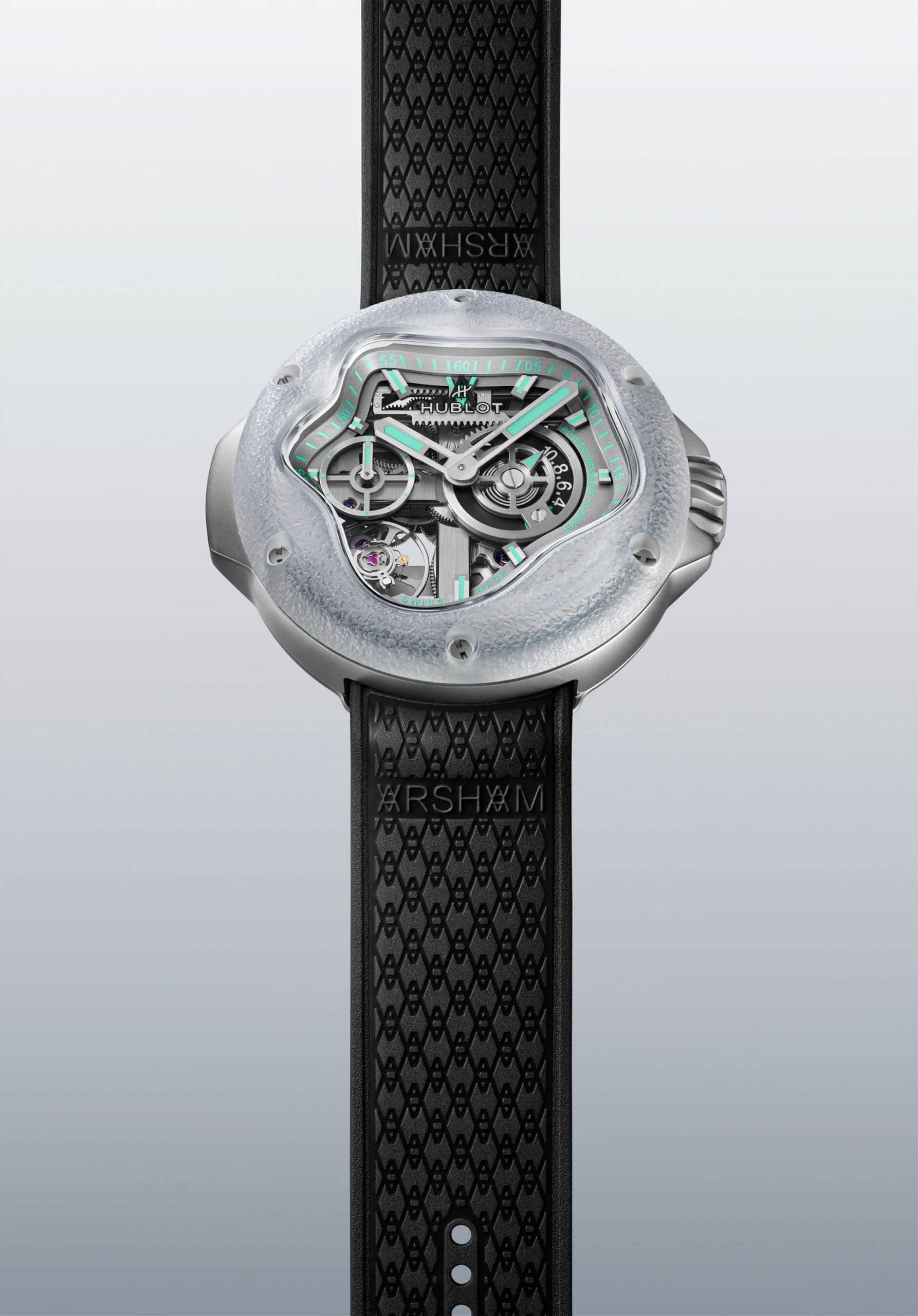
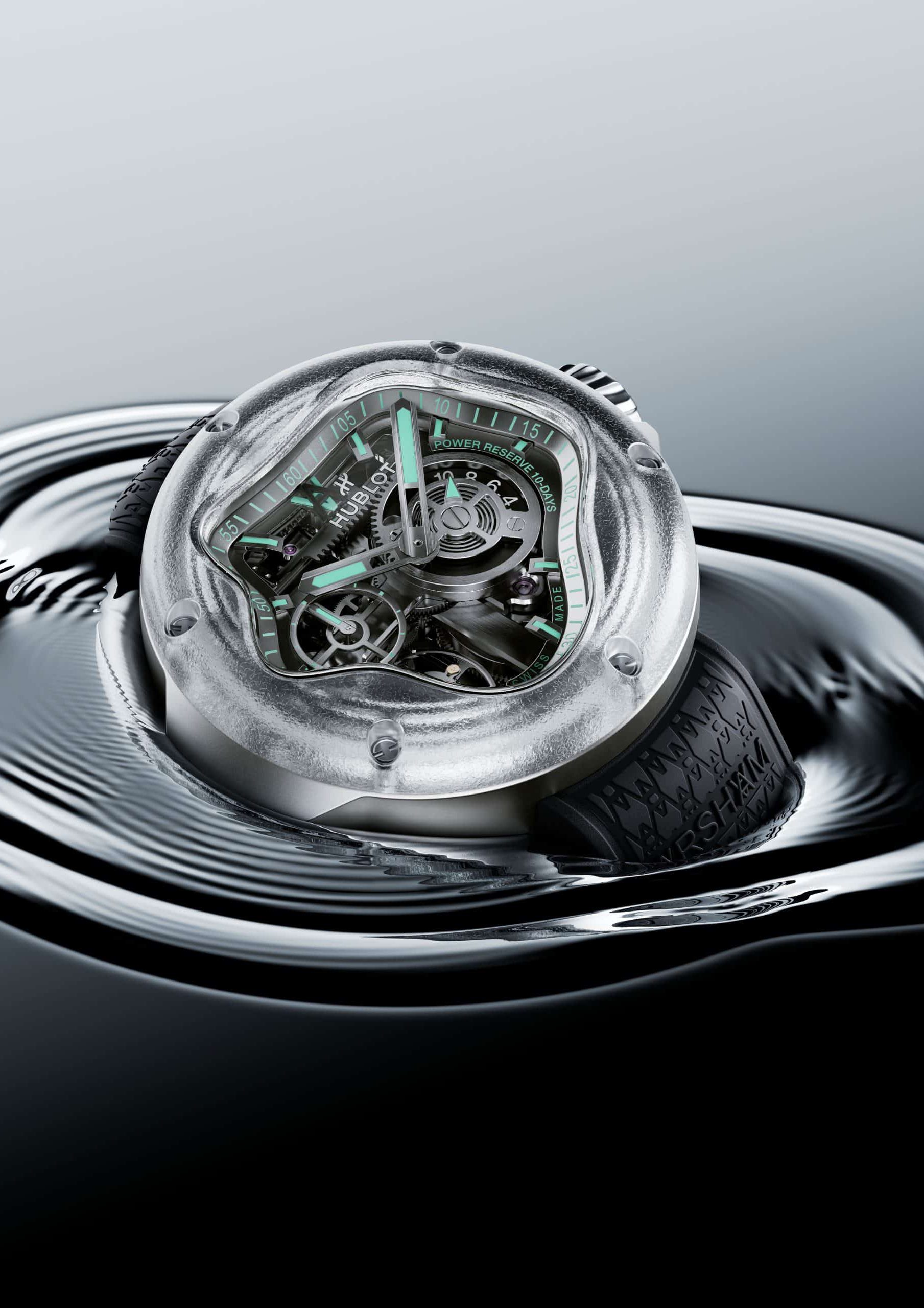
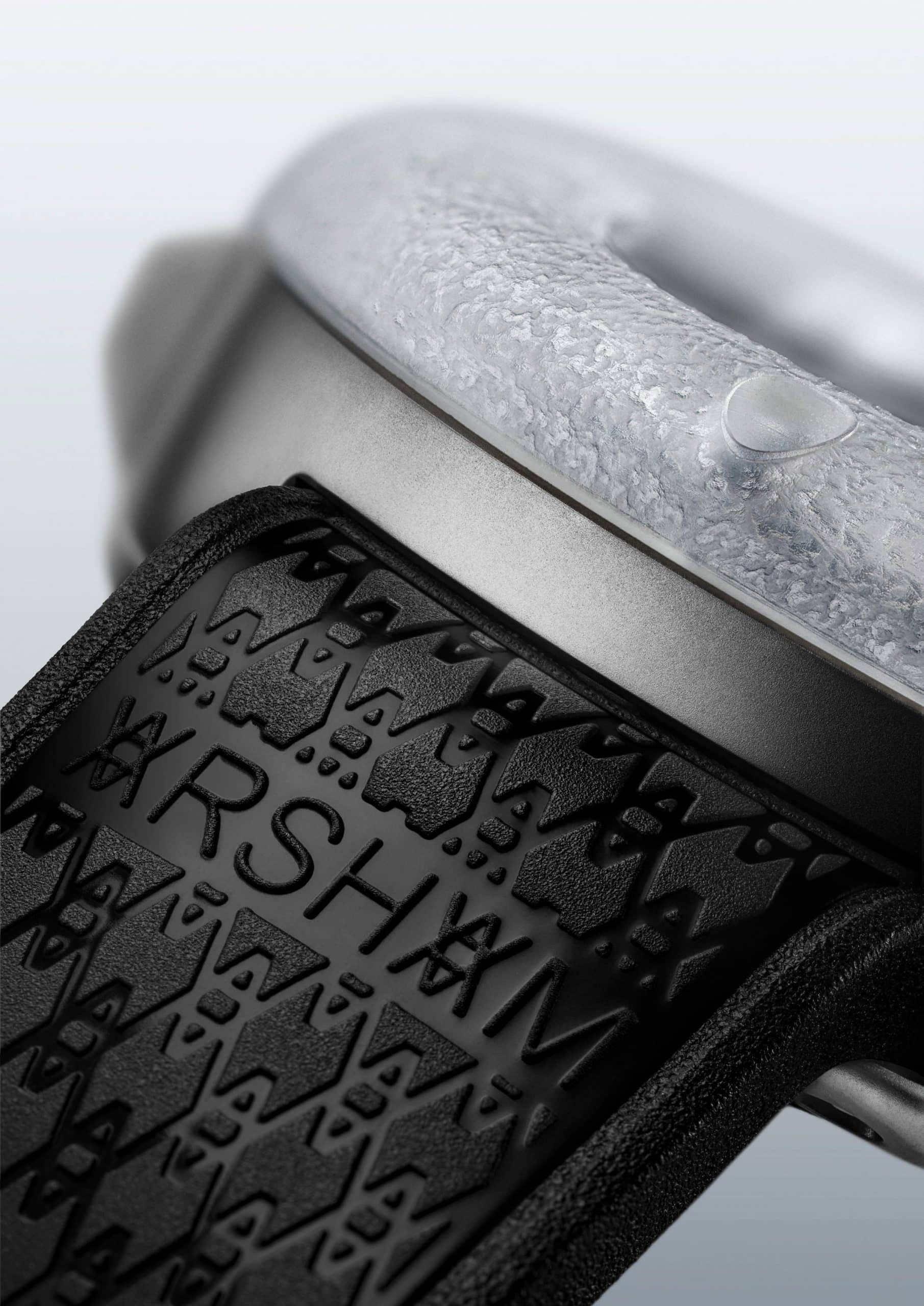
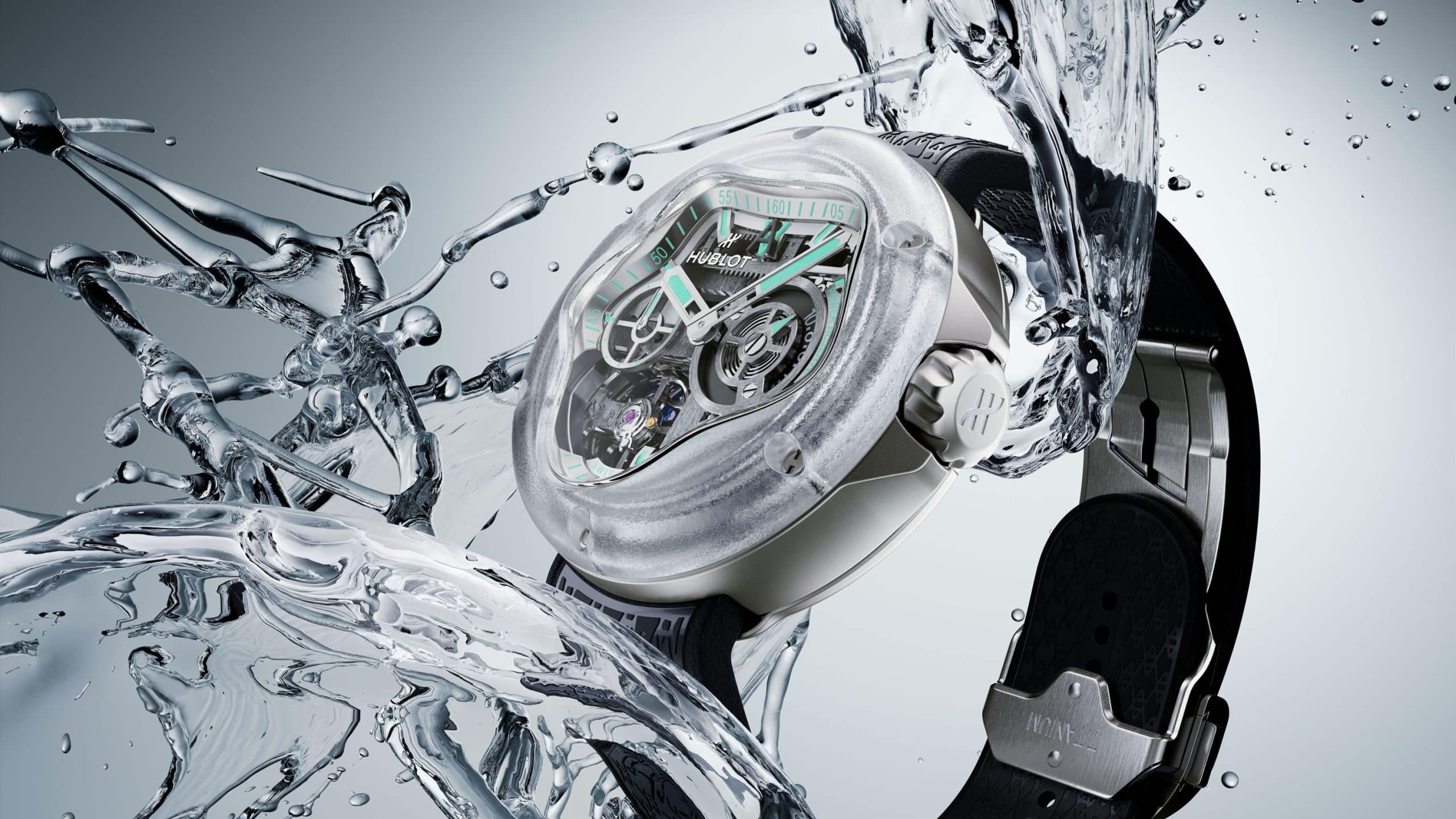
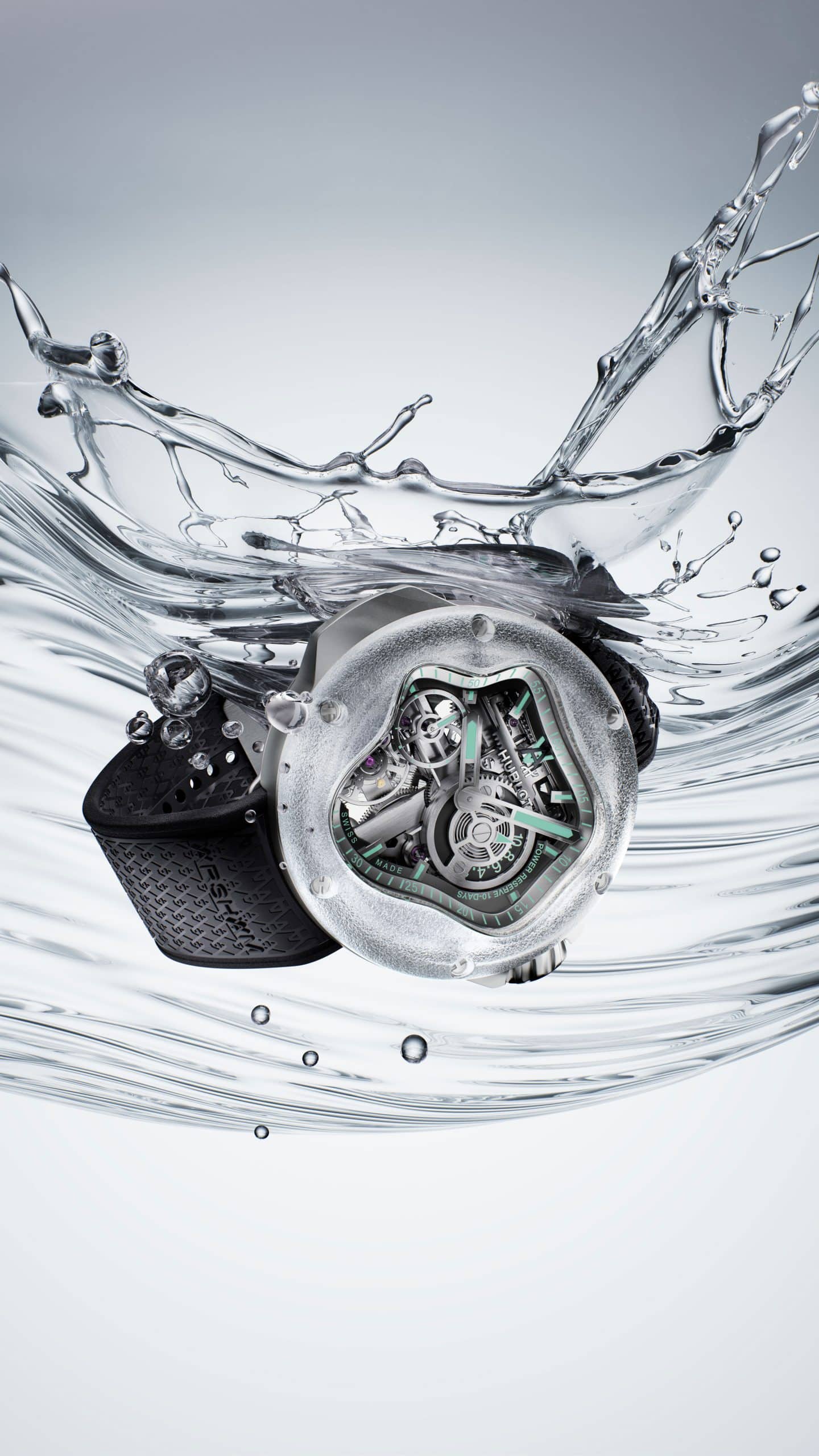
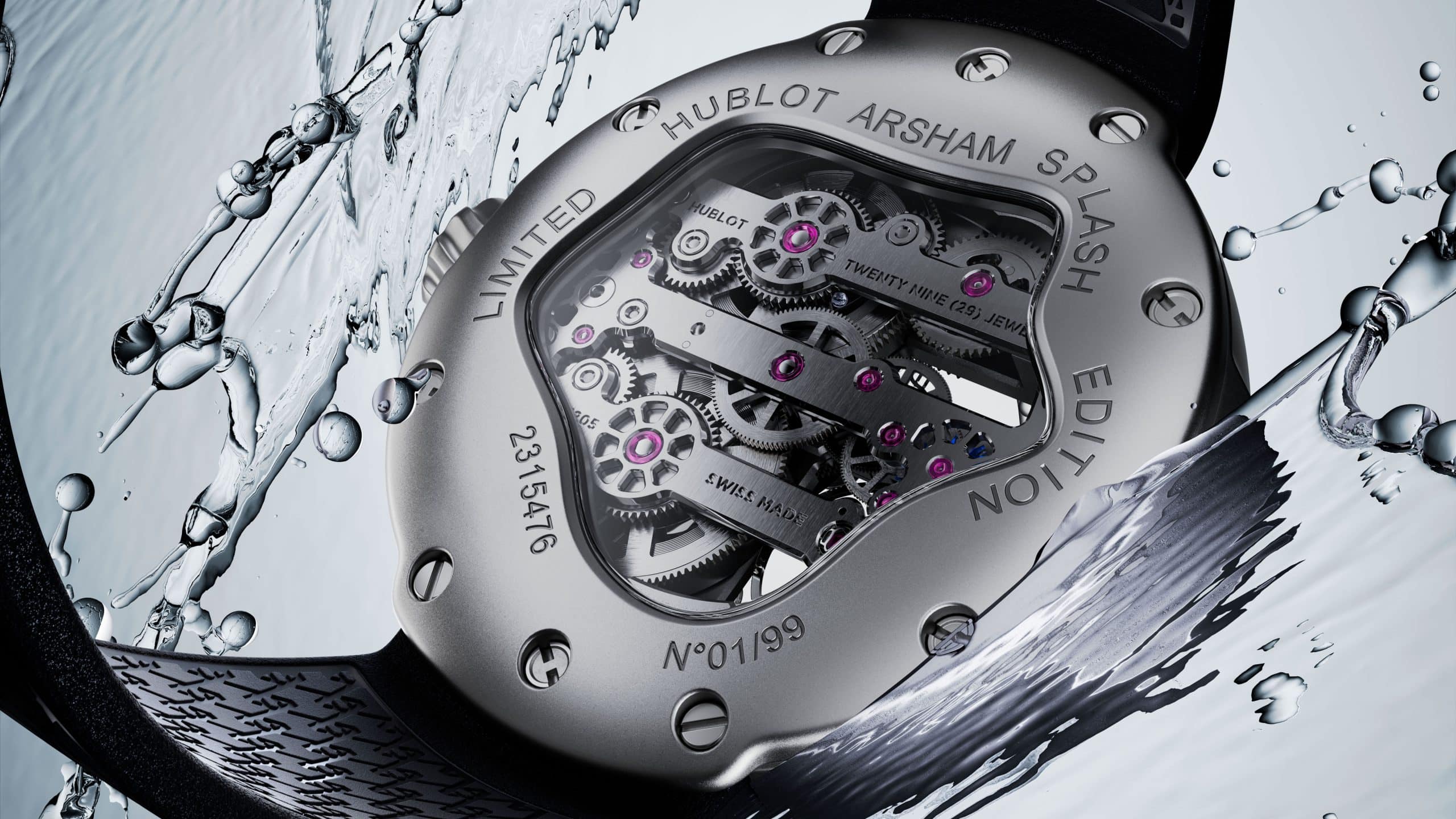
The MP-17 is 42mm of sapphire, titanium and rubber, powered by the in-house Meca-10 movement, with a reminiscent splash-shaped aperture revealing the rhythmic pulse of the 10-day reserve. Limited to 99 pieces, it’s something like performance art, but for your arm.

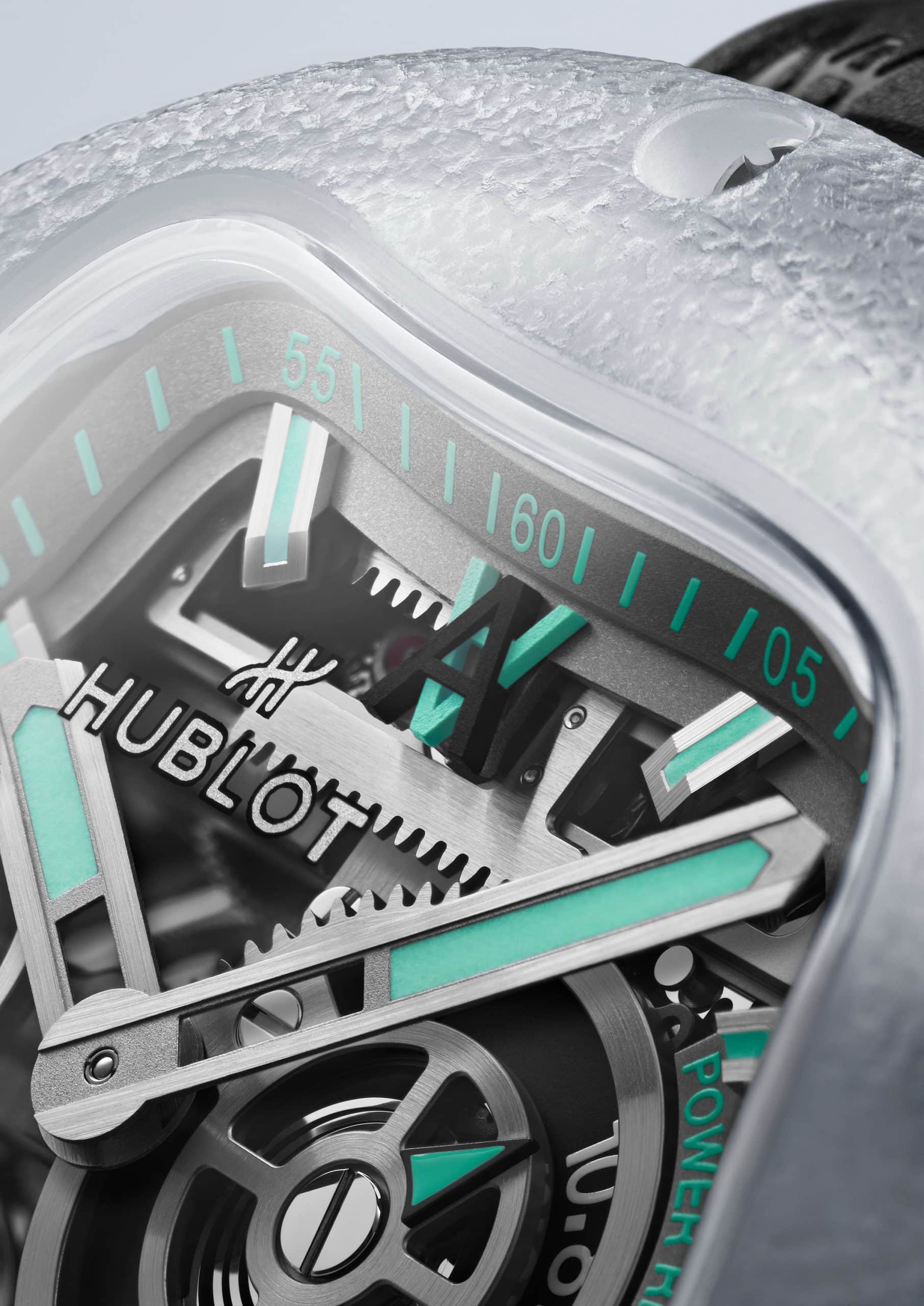
While the watch looks unlike anything Hublot has done before, there are many of the signature codes – the six H-screws on the bezel and caseback, the distinctive lugs at 3 and 9 o’clock, and the titanium H-shaped folding clasp. Signature Arsham green details highlight the hour and minute hands, numerals, markers, the small seconds at 9 o’clock, and the power-reserve indicator at 3 o’clock.

We caught up with Julien and Daniel at the Raffles press conference, and also later that night at the party (complete with hydraulic watch-revelation installation) to discuss their journey so far.

Courtesy of Hublot

WILLIAM BUCKLEY: Swiss watchmaking is often seen as quite conservative. How has Hublot positioned itself differently, and how does this new collaboration with Daniel fit that philosophy?

JULIEN TORNARE: Agreed, but Hublot since day one, since its creation in 1980, took a different angle, systematically bringing something new, a new perspective, a new approach to making watches. Our founder, Mr. [Carlo] Crocco – who you may have met, and if you haven’t, I hope you will one day, because he’s a fantastic person – had the idea to make the fusion between gold with rubber, which, back in those days, was almost a crime in the conservative Swiss watch industry. But he created that trend, which now we see in many different watches, but also in different luxury goods. This watch is a fusion between Daniel’s creative design, Daniel’s way of playing with time, perspective, the past, the present, the future, and, of course, high watchmaking, with this beautiful Meca 10 movement next to sapphire and titanium.

WB: Daniel, your partnership began with Hublot in 2023. What led you to collaborate with Hublot? What aspects of the brand do you feel resonate with you as an artist?

DANIEL ARSHAM: Michael was the one who brought me onboard, and I think he rightly knew that the brand would allow me to do some crazy things. When we launched my collaboration, I said to Ricardo [Guadalupe, Hublot CEO], I want to do something that’s unusual. And he basically said, you have carte blanche to do whatever you want to do as an introduction. And this was before we even announced that I was going to be making a product.

So I said I’d like to make a 30-metre- wide sundial that’s made of ice and snow at the top of the mountain near the Matterhorn in Zermatt; we will not be selling anything, we’re literally just inviting people there to experience this kind of moment. And it was a huge artwork, right? That was about time. It was about impermanence. The entire thing melted after a couple days, and I think that was a beautiful introduction to the collaboration t that has created now two timekeeping devices that are so unusual.

WB: Julien, how do you choose the artists Hublot collaborates with? What qualities are you looking for?
JT: We look at two things: the work and the personality. Whether you are an employee, an ambassador or a friend of the brand, there has to be a natural fit with Hublot. Hublot exists to break rules, to disrupt, to surprise people. That is why these two pieces are so surprising, and why they make sense for us. Then it becomes about human connection.

With Daniel, we have not known each other for decades, but from day one I saw incredible creativity and a lot of ideas. Every time we meet, we think of new ones. Emotion and authenticity matter. A collaboration only works if there is a real connection between people.

WB: Many luxury brands work with artists now. Once an artist is on board, what makes Hublot’s approach different, and how do you define success?

JT: Hublot is only about 45 years old, and we are always looking forward. That does not mean we ignore our past. I speak regularly with our founder, and he is very proud of projects like this, but our goal is to push the brand to the next level and imagine what a watch company should be tomorrow.

To do that, we must give artists like Daniel real freedom. Of course, there are watchmaking constraints, but we try to keep them as light as possible so that he has a genuine playground. If you restrict an artist too much, you never get the best of them. We want to dare to try new things and be willing to go beyond our own codes and usual design language. That openness is what makes collaborations with artists like Daniel successful and enjoyable.

WB: Daniel, how do you balance your own artistic voice with the needs of a commercial collaboration, and how does Hublot’s Art of Fusion concept relate to your practice?

Courtesy of Hublot

DA: The collaboration really started when I visited the factory in Switzerland and saw the material possibilities. In my own work I often use materials in unusual ways. That is probably my superpower: taking a material and making it do something it is not supposed to do, so we see it differently. Hublot is very advanced with sapphire, which became central to both projects.

The pocket watch is almost a ridiculous object to make today, but for me it is a study in possibilities. When I presented the idea back to the team, there was some nervous laughter, but the drawings convinced everyone that it could showcase what both the brand and I could do, in a way that had not been seen before, not only at Hublot but in the industry.

WB: Your first ‘product’ piece for Hublot was the Droplet, and now you have the MP-17 Arsham Splash wristwatch. Both center on water. What was the reason for that?

DA: With the Droplet, I wanted to explore the thickness of sapphire. It is probably the largest commercially produced sapphire ever made in watchmaking, which brought huge technical challenges. What I love is how it bends light. A water droplet curves and pushes light around, and that became the reference.

The Droplet uses sapphire and a titanium core, and we also adapted Hublot’s clip system to make a double-sided mechanism that lets you wear it as a pocket watch or as a necklace. It became a very versatile object, a study in materials and design. That logic continues into the Splash.

WB: Julien, what challenges and opportunities did this collaboration present to Hublot’s watchmakers?

Courtesy of Hublot

Courtesy of Hublot

JT: Once you give an artist freedom, the workshop has to turn concept into reality. A watch has constraints at every level: design, movement, reliability. Here, Daniel’s shape and design pushed our teams to the limit again. They had to find the right balance between elegance and functionality, mixing titanium with sapphire, achieving a frosted effect on the sapphire, and still displaying our Meca-10 movement with its 10-day power reserve clearly. The openings and proportions had to be perfect.

At first, our watchmakers are usually shocked. Then they feel challenged and they love it. At Hublot you need to enjoy going further and further. If you do not like challenges, you probably do not work here.

WB: Daniel, you have a background in architecture; you work with so many mediums – volcanic ash, crystal, even sound. What’s the perspective there?

DA: I get bored easily in the studio, so I move between a lot of things. The thread that connects my work, whether it is sculpture or collaborations, is a particular play with materials.

The pieces always look like something recognizable, so there is a story in the image, but the material tells another story. An object made of volcanic ash or quartz crystal speaks differently than one made of marble or bronze. That double reading is important to me, and it is also what I try to bring into collaborations.

WB: For the wristwatch, how did you evolve the idea of the Droplet into something for the wrist, while still honoring Hublot’s design language?

Courtesy of Hublot

DA: The Droplet pocket watch was designed around how it feels in the hand. It did not have to live on the wrist, so it could be heavy, double-sided, with full sapphire on both sides. Translating that into a wristwatch, I wanted to keep the asymmetry. Most of watchmaking is very symmetrical, especially in how time and information are displayed.

The challenge was to create something clearly asymmetrical that still allows you to read the time and the power reserve instantly. We made many studies of shapes, 3D printed them and wore them to understand comfort. As Julien said, the watch still has to function. The process took about two years to get right.

WB: What do you hope collectors and enthusiasts feel when they encounter these pieces?

DA: Both timepieces already feel like something you might discover 50 years from now. They look futuristic, but I hope they are also timeless. When I started working with Hublot, I told Julien my dream was to create something iconic within the brand, a design people would associate with Hublot itself. I think we have taken a real step toward that.

JT: From the Hublot side, I hope people feel how meaningful this kind of collaboration is for us. This is how we live as a brand: by surprising people with different shapes, designs, materials and looks. Our clients come to Hublot for that emotional connection between a brand and an artist. Authenticity is essential. Engagement too.

Daniel is deeply involved in every detail, all year long during the project, and you can feel that in the final watch. There are only 99 pieces, so not many people will own one, but those who do will sense that it is the result of a real dialogue and hard work on both sides. It is exciting, rare and exclusive. That is exactly what we wanted to achieve.

Courtesy of Hublot

END OF STORY