Written By: William Buckley

In Serpenti Infinito, Bvlgari's most enduring icon sheds its skin once again. Sorbet speaks to curators Gislain Aucremanne and Sean Anderson about the transformation.

Heritage is often mistaken for nostalgia. For Gislain Aucremanne, Bvlgari’s heritage curator and director, it is a working practice – a way of studying continuity through craftsmanship. With a background in art history and museum curation, he oversees an archive that stretches across nearly a century and a half of design. His work revolves around jewels, sketches, letters, and photographs that together form the brand’s memory. It is a demanding balance of preservation, research, and storytelling.

Courtesy of Bvlgari

The Bvlgari heritage collection includes around a thousand pieces: jewels, watches, silver objects, handbags, and unique commissions. Each one represents both an aesthetic and a moment in time. Alongside the physical collection sits the paper archive – drawings, correspondence, family records, and notes that trace how the House evolved. The archive functions less as storage than as an active source of reference. It informs new creations, exhibitions, and the brand’s understanding of its own language.

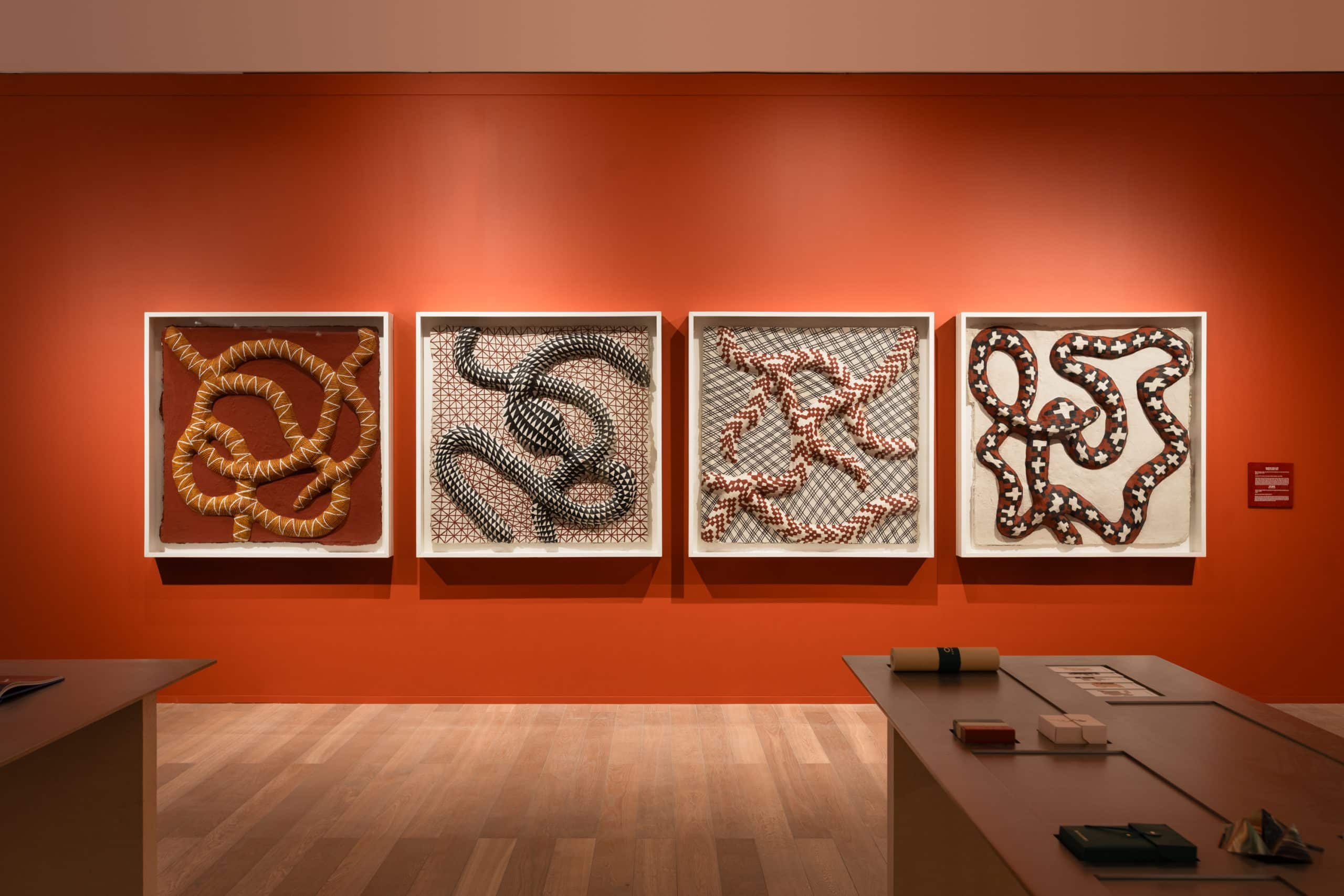
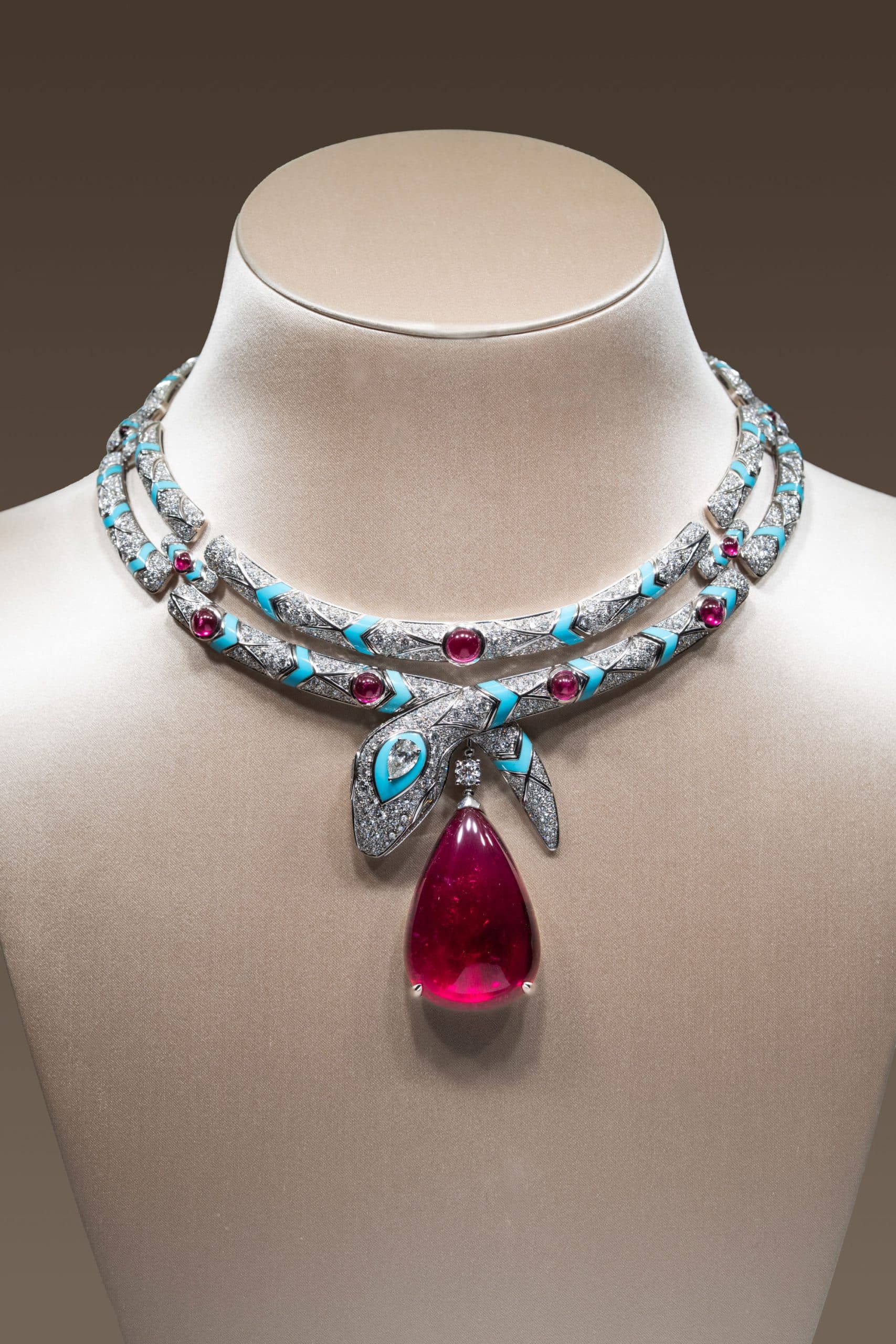
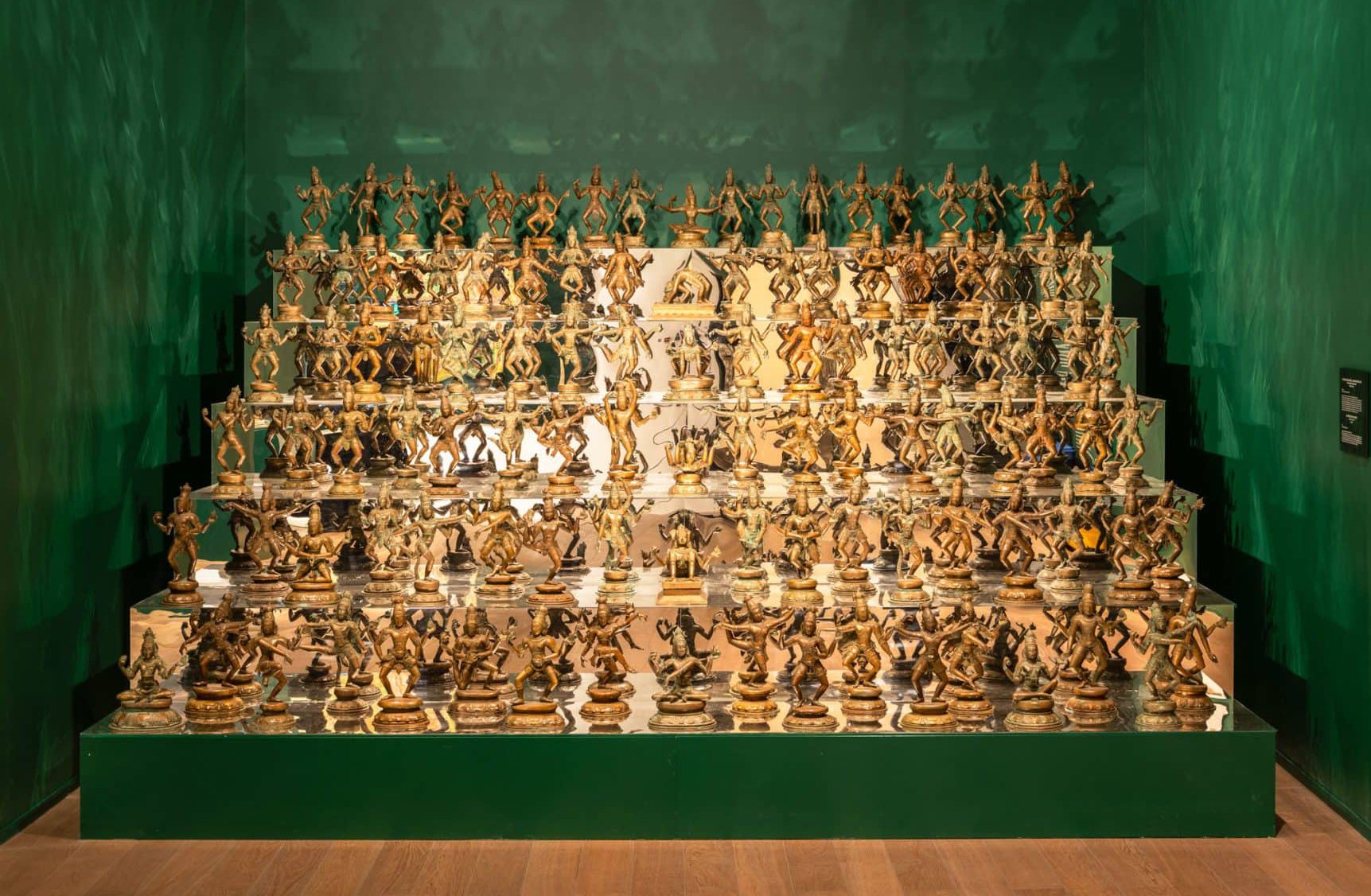
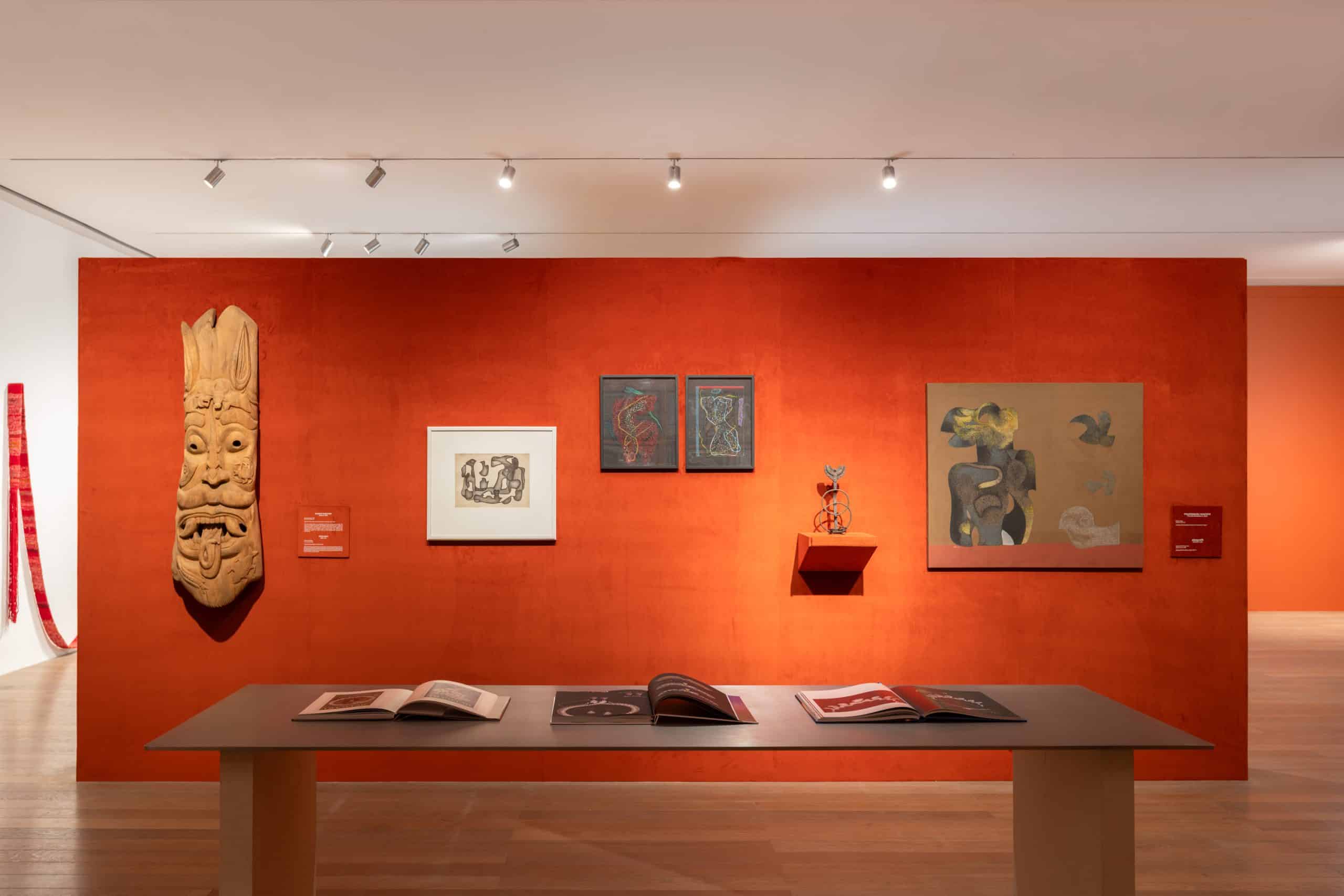
One of Gislain’s recent projects, Serpenti Infinito, in Mumbai, approached the snake motif as a universal cultural symbol. Rather than treating it as decoration, the exhibition examined its many layers of meaning, from mythology to modern design. Through collaborations with Indian artists and curators, it connected Bvlgari’s iconography with local traditions, presenting the serpent as a shared emblem of renewal and strength. The show demonstrated how heritage can travel, adapt, and find relevance across contexts.

The Serpenti Infinito exhibition was curated by Sean Anderson, whose background in both architecture and museum practice shaped the exhibition’s sense of movement and spatial dialogue. Sean approached the show as an unfolding narrative rather than a static display, weaving together history, mythology, and design through a fluid choreography of space. His curatorial process was rooted in reciprocity – allowing Bvlgari’s jewelry and contemporary artworks to mirror and amplify each other’s forms and meanings. The serpent, or nāga, appeared not only as a motif but as an organizing spirit, linking past, present, and future within the exhibition’s structure. Sean’s approach emphasized interpretation over instruction, inviting visitors to experience jewelry as art and transformation as a shared human condition. His thoughtful orchestration of time, space, and symbolism gave Serpenti Infinito its distinct resonance – a meditation on continuity, metamorphosis, and the enduring power of the serpent’s gaze.

We spoke to Gislain and Sean about their work and the extraordinary exhibition.
Courtesy of Bvlgari

Courtesy of Bvlgari

WILLIAM BUCKLEY: What inspired Serpenti Infinito, and how did the concept take shape?

GISLAIN AUCREMANNE: The starting point was the Year of the Snake. For Bvlgari, that’s more than a zodiac coincidence – the serpent has always been a symbol of transformation and power, one of the Maison’s enduring icons. The idea was to explore its universality: how this animal has existed in mythology, religion, and art across civilizations. Snakes and birds are the two creatures most represented in human history because they live in worlds we can’t – underground and in the sky. Both connect to the divine. The serpent, especially, carries meanings of protection, wisdom, and rebirth. When we decided to bring Serpenti Infinito to India, it felt almost inevitable. India has one of the richest histories of jewelry and a deep spiritual relationship with the nāga, the protective serpent. The exhibition became a cultural conversation – Bvlgari’s serpent meeting India’s serpent.

SEAN ANDERSON: For me, the project began with the question of transformation itself. The nāga is both a being and a metaphor. It appears, disappears, and reemerges across time – just as art, design, and identity do. I wanted the exhibition to mirror that constant renewal. So, rather than a linear narrative, we built something that felt cyclical and fluid. Every floor of the Nita Mukesh Ambani Cultural Center (NMACC) represented a realm the nāga inhabits – earth, water, air – and a temporal rhythm: past, present, and future coexisting in motion.

WB: How did your collaboration shape the exhibition’s balance between heritage and contemporary expression?

SA: From the outset, our dialogue was about reciprocity. The jewelry and the artworks needed to speak to one another – neither should dominate. Bvlgari’s pieces already carry stories within them, so my role was to create a space where those stories could expand. I approached it as choreography, not display. Every object was placed with intention, to suggest transformation, continuity, and presence.

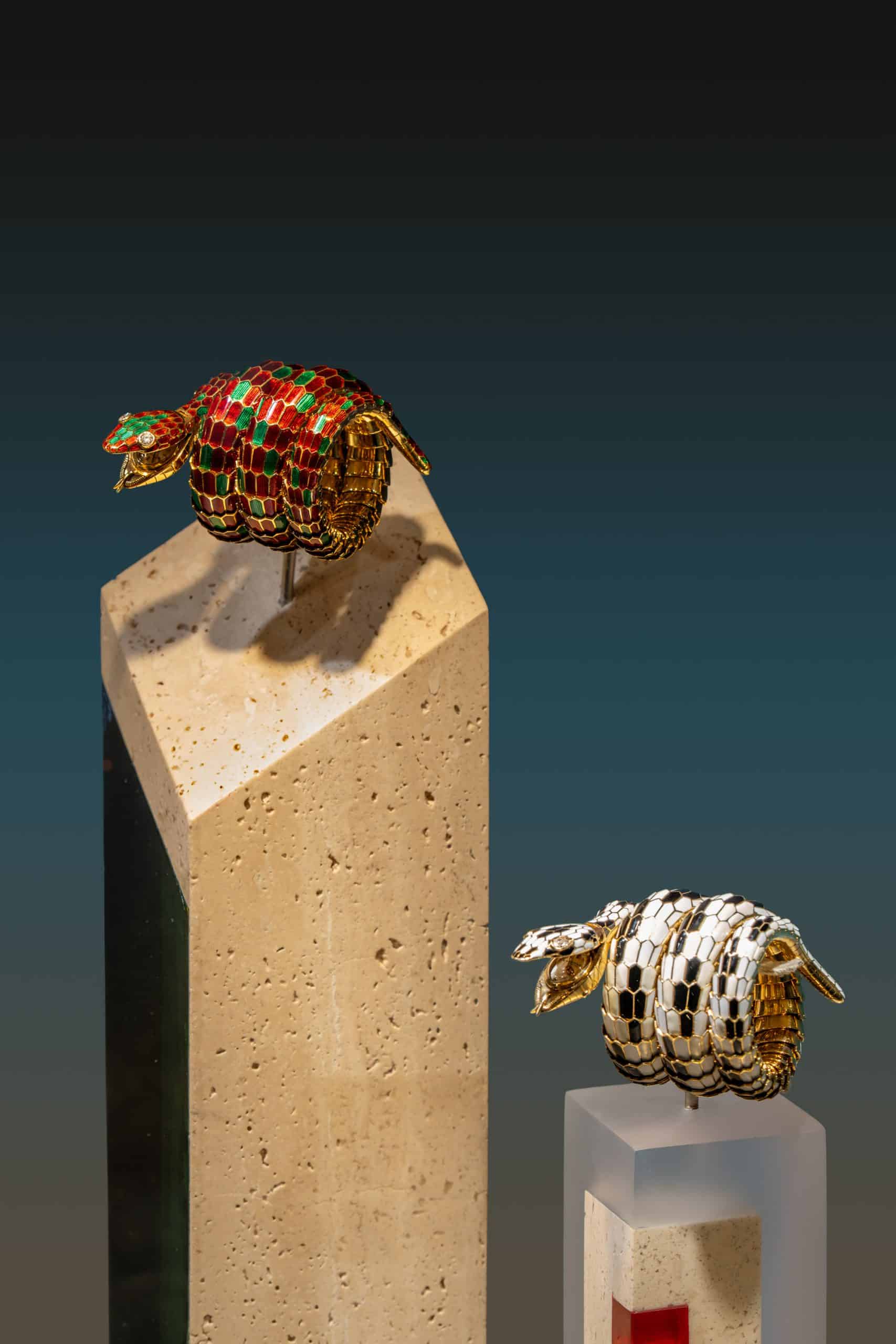
GA: And, for me, the archive was the foundation. I began by asking: what do we want people to learn, not just see? You can walk through a beautiful exhibition and forget it the next day, but if you understand why something was made, or how it connects to a cultural moment, you take something with you. I chose pieces that reflected Bvlgari’s technical and artistic evolution – tubogas, enamelling, gemstone work – all crafts that still define us. It was about showing lineage without imitation.

WB: Sean, how did the Mumbai location influence your approach?

SA: Every exhibition is a negotiation with space. The NMACC’s Art House is both generous and demanding – its architecture dictates how people move, how they see. I visited multiple times before finalizing anything. I wanted the serpent to guide the flow, so we worked with subtle transitions between floors. I rearranged almost every piece during installation to achieve that rhythm. I also considered the visitor’s emotional journey – how light, proximity, and movement could evoke wonder without overwhelming. I initially thought of placing artworks outside the galleries, creating visual invitations in public areas, but eventually decided to keep everything within. The result was more concentrated, more meditative.

Courtesy of Bvlgari

Courtesy of Bvlgari

WB: What was your process for selecting the jewelry pieces?

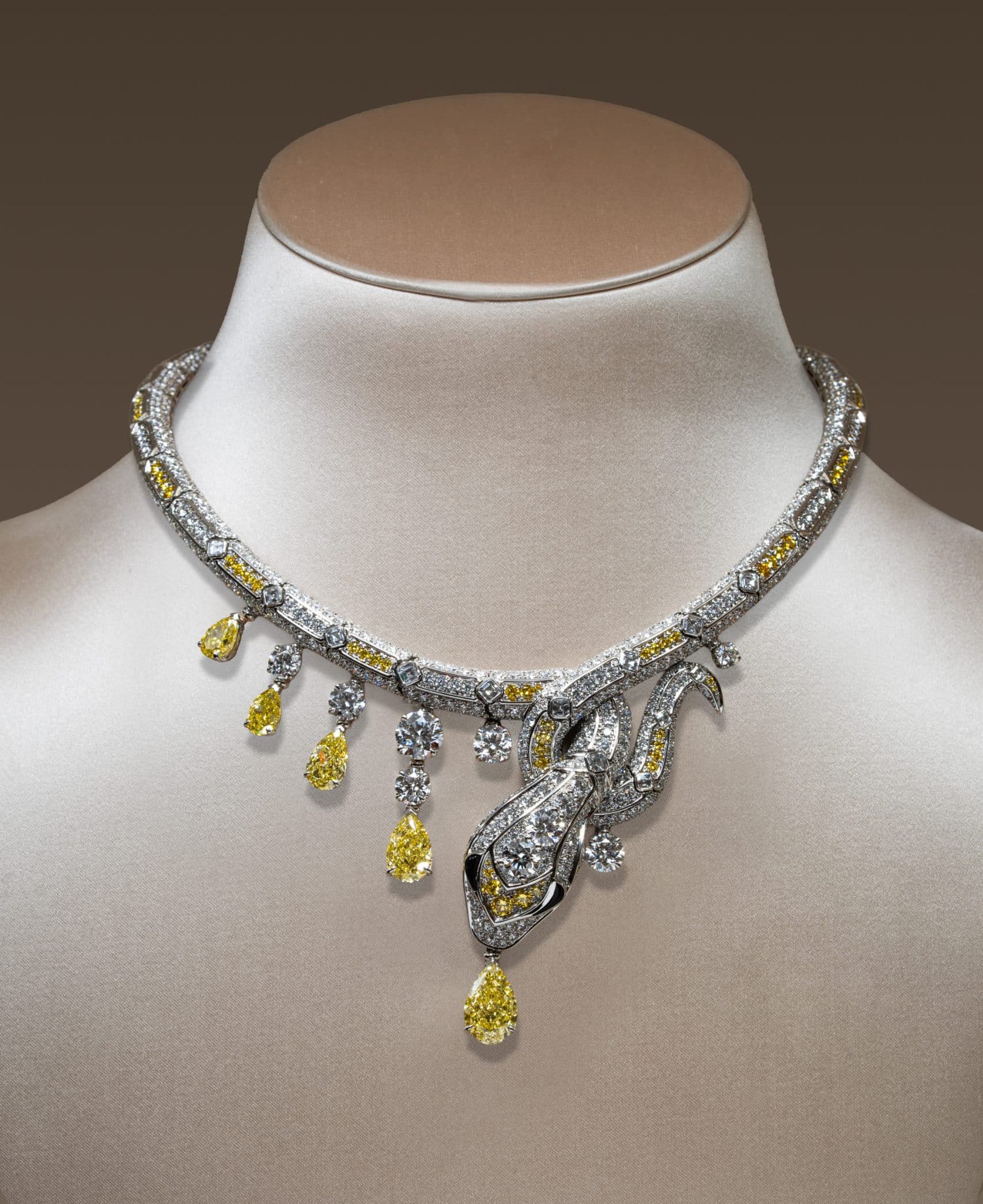
GA: We have an expression: choosing is renouncing. Out of more than a thousand pieces, we selected 25 to 30. The aim was to show the serpent’s many lives – as craftsmanship, as design, as metaphor. I wanted visitors to see the technical range: from flexible tubogas coils to the vibrant enamels, from the precision of goldsmithing to the sculptural presence of gemstones.

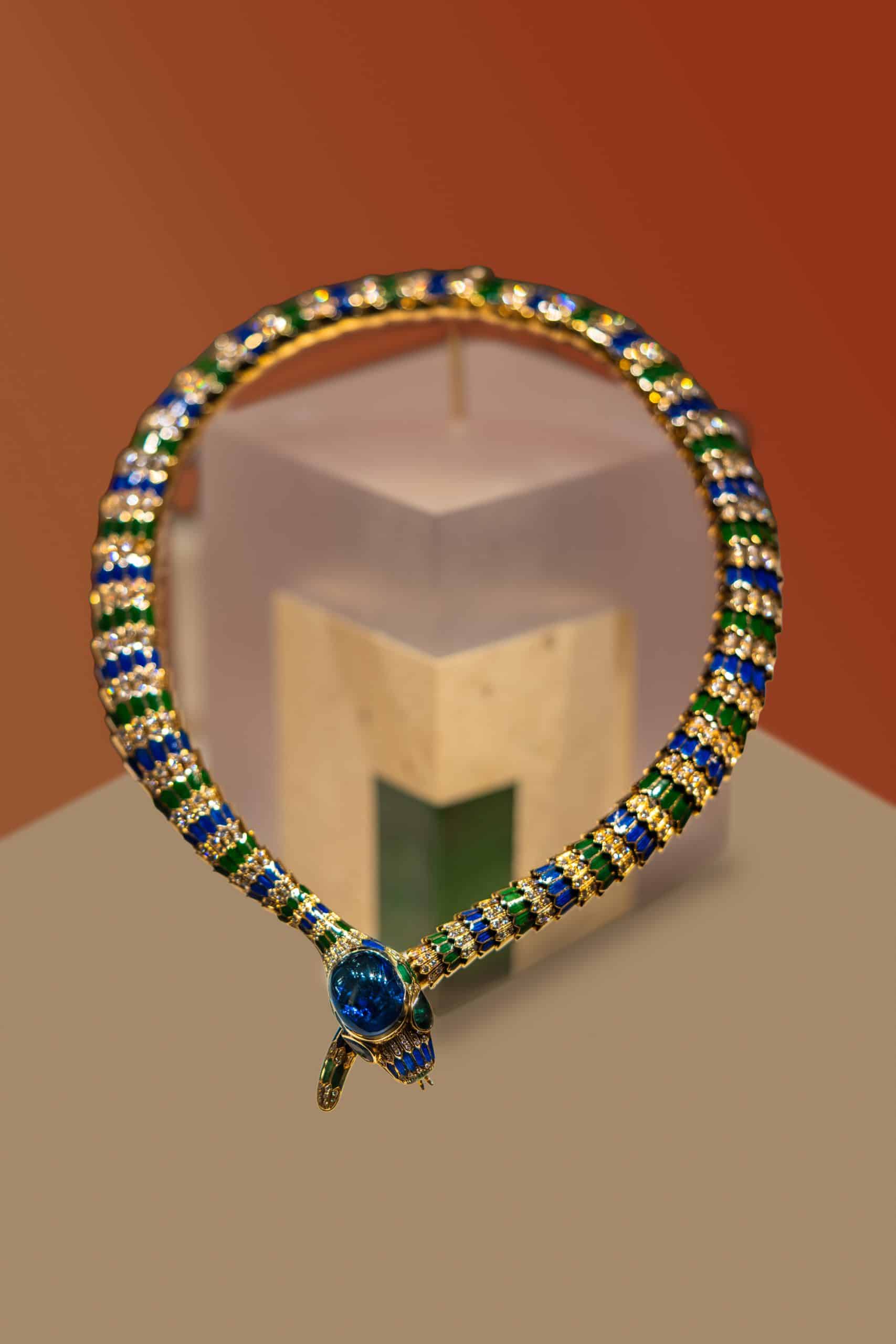
One of my favorites is a necklace in yellow gold with blue and green enamelling, a gentle snake head with a sapphire cabochon. The colors evoke India – the richness of its light, its textiles, its history. Selecting it felt right for this exhibition. And yes, there are always pieces I wish I could have included, but that limitation forces clarity.

WB: How do you both view the serpent as a metaphor within this project?

SA: The serpent is both mirror and teacher. In mythology, it represents transformation and the dual nature of creation and danger. It sheds its skin – dies and is reborn – a cycle that speaks to what art and life constantly do. For me, Serpenti Infinito was about that capacity to become other, to imagine differently. Jewelry performs a similar act. When we adorn ourselves, we shift identity, however subtly. That act is both personal and universal.

GA: I completely agree. The serpent for Bvlgari has never been an evil symbol – it’s protective, wise, powerful. From ancient Egypt to Rome to India, it has always embodied strength and regeneration. That’s why it endures. It’s not a trend; it’s a reflection of how humans have always seen themselves.

WB: The exhibition integrated local Indian artists and traditions. How did that collaboration work?

Courtesy of Bvlgari

GA: It was essential to work with local voices. We partnered with Indian curators and artists to ensure authenticity and sensitivity. Each artist brought a unique interpretation of the serpent – as a protector, a spiritual force, or an abstract form. The dialogue between Bvlgari’s heritage and contemporary Indian creativity created a richer story.

SA: Those collaborations were vital. I didn’t want the show to be an imposition of one perspective but a shared creation. Many of the contemporary artists, like Baua Devi, explored the serpent as a narrative being – something that reflects human behavior and emotion. Their works were not just illustrations but meditations on transformation, mirroring the same ideas in Bvlgari’s pieces.

WB: What kind of experience did you hope visitors would have?

SA: I don’t believe exhibitions should resolve anything. They should invite inquiry. Visitors might not remember a specific work, but they’ll remember the feeling – the light, the texture, the hum of the space. Meaning lives in that afterimage. Even a single photograph saved on a phone can carry the presence of what they felt.

GA: I think about knowledge and emotion together. People today want to understand why something matters, not just that it’s beautiful. Heritage exhibitions like this give context – they show how design, art, and culture evolve together. For me, the greatest success is when a visitor walks away with curiosity – when they see a jewel and realize it’s part of a much larger human story.

WB: What keeps the work of heritage and curation alive for you?

Courtesy of Bvlgari

GA: The discovery. The archive is endless – drawings, letters, forgotten commissions. Every time we find something new, it changes how we see the past. Heritage is a living thing; it grows through research, through exhibitions, through conversation.

SA: For me, it’s the encounter. Every exhibition is an act of becoming – for the curator, the artist, and the audience. Serpenti Infinito reminded me that symbols survive because they evolve. The serpent sheds its skin, but never its meaning. That’s the lesson of heritage, and of art itself.

WB: Finally what are your favorite flavors of sorbet?

SA: I prefer gelato, but, okay… sorbet… especially on a humid day: coconut and frutti di bosco.

GA: I’m a lemon lover. Lemon in Italy is life. When it’s really hot outside, you take a lemon granita, and it cools you down. It’s pure magic, truly. I love many kinds of sorbet, especially exotic fruit flavors, but lemon has something special in Italy.

I’m not even Italian – I just think it’s one of the things I love most about being here. The sorbets and the gelato are simply better in Italy.

Courtesy of Bvlgari

END OF STORY